
It was my father’s dream to see the mountain gorillas long before it was mine. He had intended to go decades before but political unrest made it too dangerous to travel to Central Africa. After four years of planning and saving, this was the part of the trip I was most looking forward to, but when it was time to leave, I was conflicted. My father was in the ICU of the hospital. Emergency surgery two days before had repaired a tear in his small intestine, but he was still in poor shape. I dreaded the thought that something would go wrong while I was in a remote forest living out his dream. Would I ever be able to forgive myself if he contracted an infection and passed away? Fortunately, that was not the case, and he returned home a few days after our arrival in Uganda.
Now the primary purpose of this post is to describe our experience gorilla trekking, so I don’t want to spend too long talking about our amazing stay at Bwindi Lodge; however, I must briefly recognize the warm and wonderful staff who took care of us, our beautiful banda (room), and the exceptional food. If the people we met are any indication of the community at large, then the people of Bwindi are genuine, soft-spoken and kind. They make excellent meals and have the very best smiles!

Background on Bwindi and Day 1
Mountain gorillas live in the misty forests of the Virunga Massif and Bwindi Impenetrable Forest. There are only about 1,000 mountain gorillas left in the world, and the only way to see them is to trek into their habitat in Rwanda, Uganda, or the Democratic Republic of the Congo. They cannot survive in captivity. Permits to visit the gorillas are $700 per day in Uganda and $1500 per day in Rwanda. They are less in the DRC, but the area is much more dangerous. I’m all for the permits. They raise the money necessary to protect these endangered primates and also control the number of people who visit them at a time. In Bwindi, there are 21 habituated gorilla families, and only 8 people can visit each family for a single hour per day. Given all of these factors, we chose to go to Uganda and see the gorillas on two consecutive days.
We arrived in the early afternoon our first day in Bwindi and signed up for a “nature walk”. We were accompanied by a knowledgeable guide and two armed guards who were there to protect us from poachers and rebels from the Congo. I made two rookie mistakes this day. First, I didn’t realize that the walk took place in the National Park and wasn’t arranged by the lodge, so I failed to bring money to tip them (I returned later to rectify this), and second, I came to understand that a “nature walk” means something different in Uganda with its naturally mountainous terrain than it does in Florida where the only way to get a calf workout is to set a treadmill on an incline. Both my husband and I had reservations about what the treks would be like the next two days if this was a “walk”.

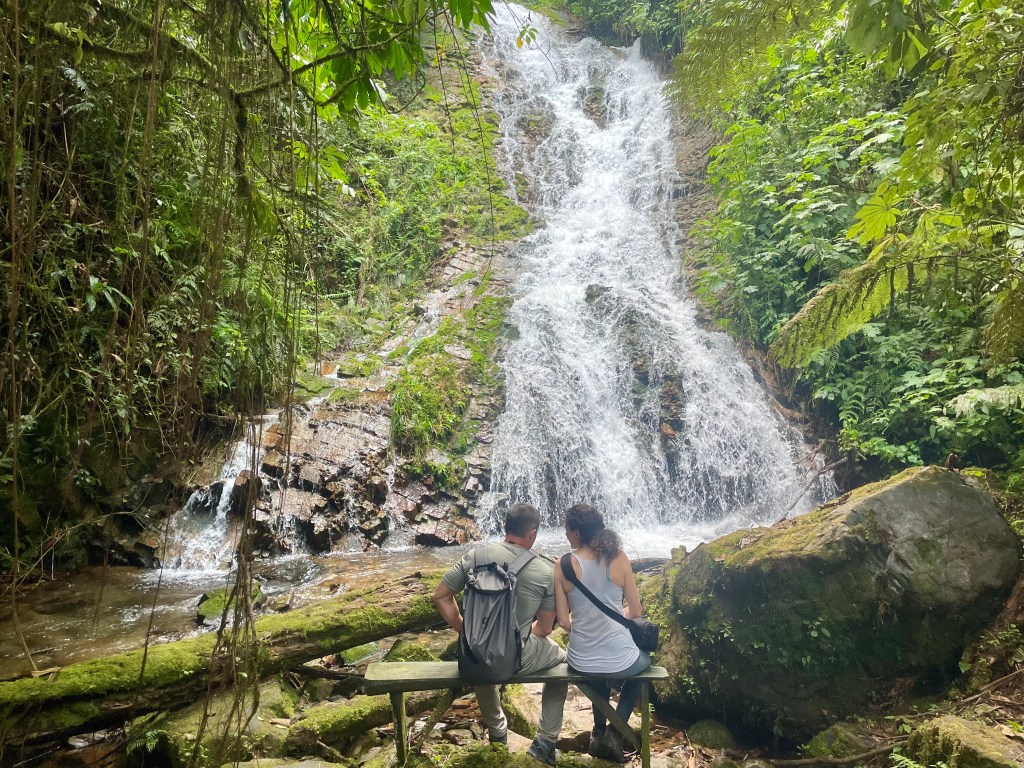
Gorilla Trek 1
The next morning we were driven to the Bwindi Impenetrable Forest National Park building at 7:45 a.m. To protect the mountain gorillas from communicable diseases, our temperatures were taken and we were given masks to wear during the hour we were with them. We were reminded to keep a distance of 10 meters from the gorillas. Then the park attendants checked our permits and invited us to have a seat for a short presentation. First a group of women raising money for bicycles for women sang and danced, and then we were told what to expect from our trek. During this time, representatives from each lodge convened to discuss which family group each visitor should see based on their overall fitness. I pointed to a young, extremely fit couple and whispered to my husband, “I hope we’re not with them. They look really in shape. Maybe we should have downplayed how much we exercise.” But of course, the first group to assemble was ours, and we were called up at the same time.

The trek itself was better than I expected. Bwindi Lodge gave us sticks, leg gaiters, and a delicious lunch, and we gladly accepted the offer to hire a porter to carry our bag. (The porters cost only $15 for the entire trek, and they will hold your hand and literally push and pull you up the mountain as needed. I found the porter most helpful on the way down as that was when I was most unsure of my footing.) We were visiting the Rushegura family, and while far up the mountain, they stayed close to the trail, which meant we had a well-marked path the entire time. In two hours, we were with them!
The Rushegura gorilla family consisted of 19 individuals including 2 silverbacks, 3 blackbacks, 6 adult females, 1 sub-adult, 3 juveniles, and 4 infants. Words don’t do justice to how incredible it was to look them in the eyes and watch their interactions with one another, so I’m going to let the pictures and the video speak for themselves.


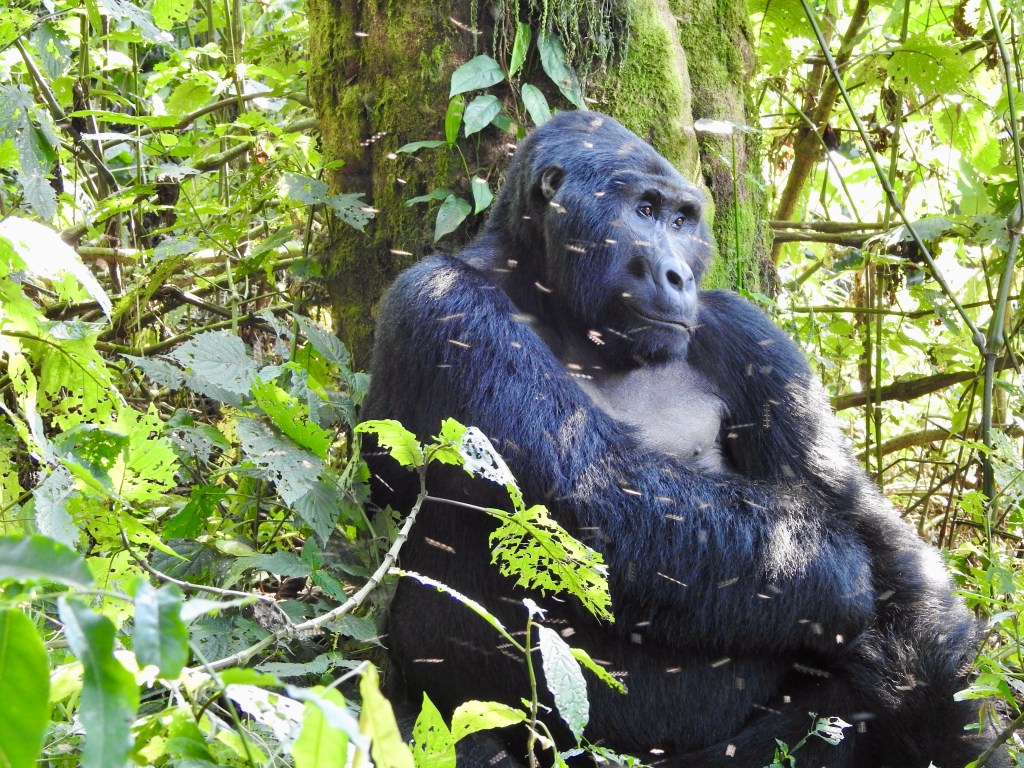
Being habituated, the gorillas seemed utterly unfazed by our company, and were encouraged to take as many pictures as we wanted. The hour was over all too quickly!

That afternoon we returned early enough to visit the Bwindi Community Hospital where we were given a tour by the communications manager. They’re doing inspiring work! Following that we each received a 30 minute massage as part of our stay at Bwindi Lodge before settling in for a relaxing evening.
Gorilla Trek 2
Day 2 began much the same way, but it soon turned into a very different experience. Though I was ready for another strenuous trek, my husband asked for an easier one since his back was hurting. I am ashamed to admit that I was disheartened when I saw our assigned group. We had asked for a mild to medium hike, but now we saw we would be trekking with six self-proclaimed birdwatchers in their 60’s and 70’s. Surely our representative had overshot the mark, and we would barely have to exert ourselves at all! Of course I was mistaken.
This time we were assigned to the Mubare Mountain gorilla group, the oldest habituated gorilla group in Bwindi Impenetrable National Park. In its current state, the family consisted of 9 individuals–1 silverback, 4 adult females, and 4 infants. When we were assembling the trackers reported the Mubare group was relatively close to our starting point, but then the family moved further into the forest. The previous day I had brought the recommended gardening gloves–to protect my hands from thorns and scratches–as well as extra water and snacks, but seeing that I didn’t need them the day before and we were on a trail the whole time, I left the extra water and snacks at the lodge. Fortunately, I did have the gloves, and thank goodness I did because we were headed right into the forest…the Impenetrable Forest, which, as it turns out is named that for a reason. Our guide ended up taking us up a trail previously marked by elephants. There were huge footprints to watch out for as well as elephant dung, and I kept wondering how such massive, heavy animals would be able to navigate these steep climbs! Also, where were these elephants? Had no one thought to warn us that we might come upon them? To be fair, I wasn’t that worried about the elephants. I was much more anxious about the poachers or rebels who could be hiding in the forest, as well as my dwindling water supply. Meanwhile, the older people in our group were handling the situation with nary a complaint or a struggle.
It took about 3.5 hours, but we finally reached the trackers who brought us to the gorillas. This group appeared to be more wary than the Rushegura family; however, I was still overwhelmed by what a privilege it was to spend time with them. Aren’t they beautiful?
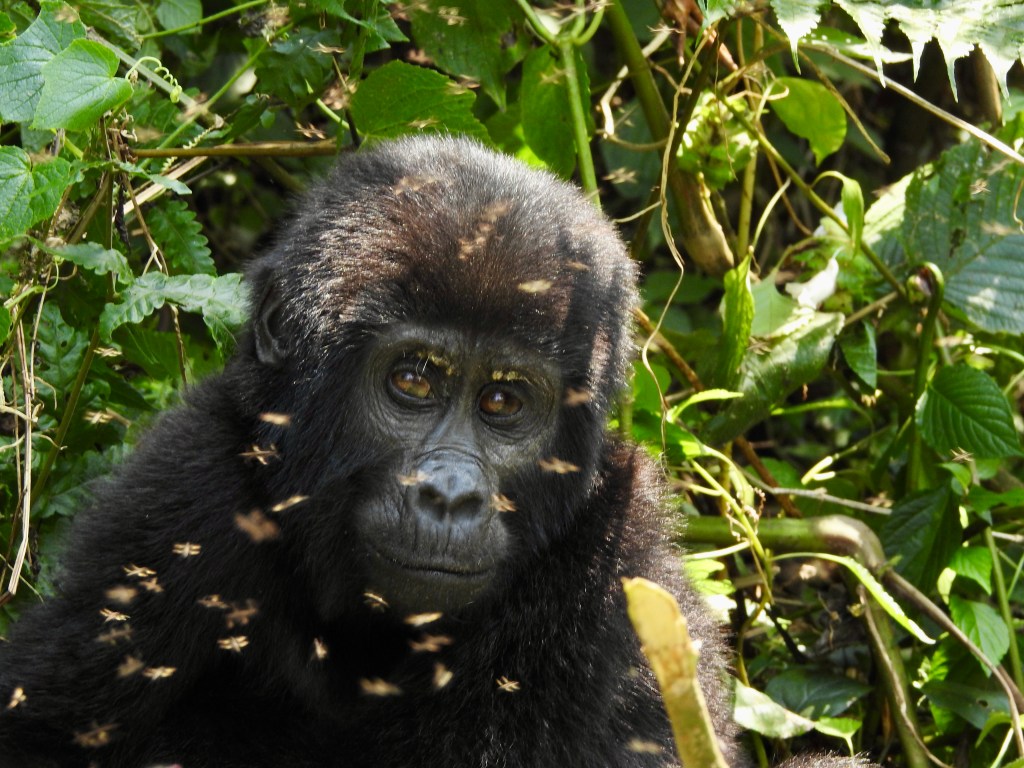
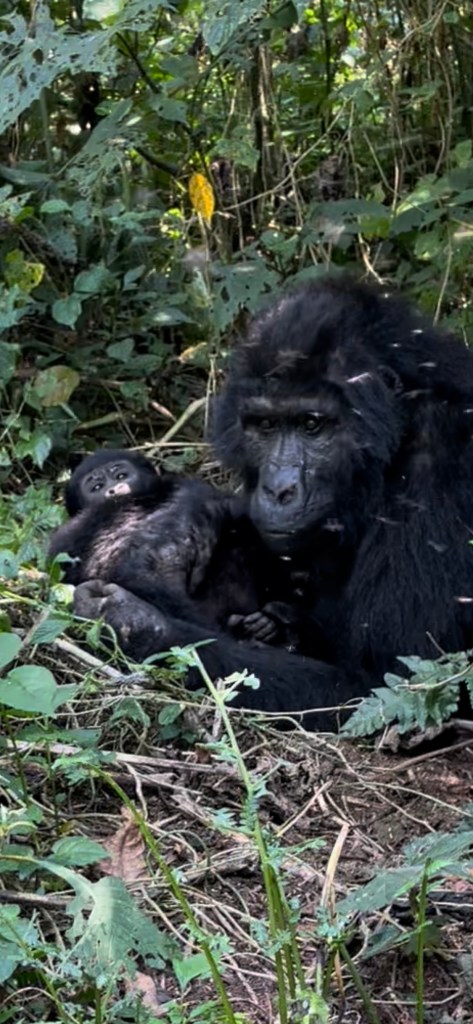
Already gorilla trekking was an unforgettable experience…
And then came my husband’s favorite moment EVER on one of our trips, and maybe even his favorite moment of our entire relationship.
We heard rustling in the trees, and we were all poised to observe, sensing that something was coming.
Now I didn’t allow my husband to post this video on social media for a few reasons. #1 – It was embarrassing. #2 – It was my fault. I should have been paying attention and moved out of her way rather than filming with my own phone. # 3 – I didn’t want anyone to think it was dangerous visiting gorillas. It’s absolutely not. They are docile, gentle giants. But John made up for the ban by showing the video in person to absolutely everyone he knows. Even our family doctor had seen it when I went in for my annual physical.
For the remainder of our trip I would hear him giggling, and I would see him playing it over and over again in slow motion. Now you might ask why did he keep filming when he saw that I was taken down by a gorilla? That would be a reasonable question, and the answer is that he didn’t realize it was me. He was just sorry for that poor woman. He claims it wasn’t until I was standing upright again that he put it together. Either way, it was a climactic end to our second trek, and I’m happy to say, I wasn’t injured in the least. And our new birdwatching friends were delightful, thoughtful companions on the return trek down.
So to recap, Gorilla trekking was even better than we imagined, and my husband loves me more than ever.
Final Notes and Lessons
Should you decide to go gorilla trekking, here are a few pieces of advice:
- Consider the options. Rwanda is an extraordinary country and well-worth a visit on its own. Though the permits cost double, the gorillas are closer and the treks are easier. I dream of bringing my father here one day so he can see the gorillas himself.
- If you do go to Bwindi, build up your endurance and elevate your heart rate with exercise beforehand.
- Wear a thin long sleeved shirt and bring gardening gloves, water, and snacks.
- If you can afford it, go for more than one trek!
And finally, here are three life lessons that I learned from gorilla trekking:
Life Lesson 1: Don’t underestimate your elders.
Life Lesson 2: Don’t expend energy worrying about perceived threats. They probably won’t happen, and something else could be coming straight at you–and it will probably be fine when it does.
Life Lesson 3: If you want to have a travel blog, it helps to have a husband who films the most memorable moments.
(Speaking of which, if you haven’t read about our trip to South Africa, you’ll want to check that out next for my husband’s video of us being charged by an elephant.)
 Wildlife & Water Adventures